
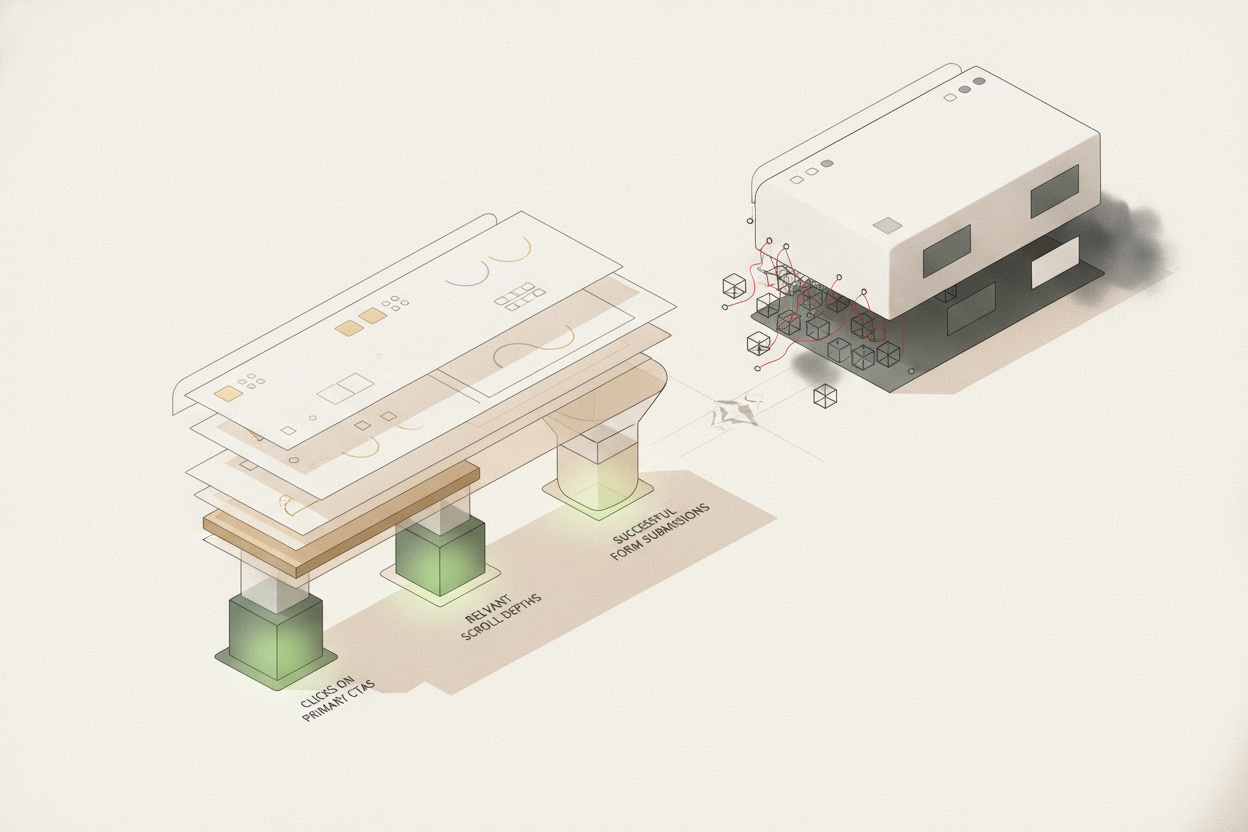
A successful marketing website requires functional tracking from day one. To evaluate launch performance properly, every new site should ship with three core analytics hooks: primary call-to-action clicks, key scroll depth, and form submission success. Setting up these foundational measurement points before going live ensures that design choices are backed by immediate behavioral data, preventing dark periods where user interactions go unrecorded.
Many marketing and design teams focus heavily on typography, motion, and visual assets, leaving website tracking as an afterthought. When measurement is delayed until weeks after launch, critical baseline data is lost forever. Implementing standard tracking hooks during development bridges the gap between creative visual execution and practical business performance. By establishing clean analytics setup routines during the build phase, teams protect their launch investment and gain instant clarity on how real visitors navigate new landing pages.
Shipping a site with core tracking built into the code prevents chaotic retroactive tagging inside tag containers. It aligns developers, designers, and marketers around defined performance metrics before public traffic arrives. This guide breaks down why post-launch tracking fails, the exact event hooks required at launch, and how to maintain a lean, accurate measurement system without slowing down site performance.
shipped designs often lack immediate performance feedback
Launching a website without tracking leaves teams blind to user behavior during the most critical post-launch period. Without basic event tracking, you cannot determine whether low conversion rates stem from poor messaging or broken navigation. Implementing primary CTA tracking, scroll triggers, and form listener hooks on release ensures immediate insight into visitor intent.
When teams prioritize aesthetics over measurement, post-launch discussions revolve around subjective opinions rather than objective interaction patterns. Visual beauty attracts traffic, but structured tracking measures engagement. Aligning copy and structure before code freeze is vital for launch success. To ensure your content framework matches these data collection needs, follow a clear framework like preventing late-stage content changes during launch to establish a strict narrative freeze before visual design begins.
Retrofitting event tags into an already published marketing website frequently results in fragmented data. Third-party scripts attached to unstable DOM elements break whenever layouts update, causing gaps in reporting. Baking standard event listeners directly into the component design system eliminates DOM dependency. It ensures that every critical interaction fires a reliable event payload regardless of future visual updates.
How do primary call-to-action hooks validate design layout?
Primary call-to-action hooks measure the exact moment a user decides to move forward in the buyer journey. Tracking primary CTA clicks reveals whether your hero section, navigation bar, and mid-page triggers successfully capture user attention. These hooks provide unambiguous data on which page positions drive the highest click-through frequency.
To build a robust CTA hook, attach explicit data attributes to your primary button components during development. Instead of listening for generic class names or visible text that might change during site maintenance, use dedicated attributes such as data-analytics-cta=’hero-primary’. This ensures that marketing site updates will never inadvertently break your conversion tracking pipelines.
Analyzing primary CTA data right after launch highlights immediate design friction. If visitors scroll past your primary button without interacting, the visual hierarchy or copy positioning may lack clarity. Early identification of these friction points enables design teams to run fast iterations based on concrete interaction data rather than speculative assumptions.
Key scroll depth tracking exposes narrative drop-off points
Scroll depth tracking identifies how far visitors read down a page before losing interest or exiting. Measuring key threshold scroll events, such as fifty percent and seventy-five percent page depth, shows whether your content narrative maintains engagement. This data pinpoints exact sections where visitor attention wanes.
Generic scroll tracking that fires every ten percent creates database noise and distorts reporting dashboards. Effective measurement focuses strictly on strategic milestones: the main value proposition, key social proof modules, and lower page action sections. Tracking these explicit viewports demonstrates whether users actually reach the contextual information needed to make informed decisions.
Combining scroll data with click patterns yields deep insights into content performance. When scroll depth is consistently high but CTA interaction remains low, the issue is rarely page engagement; it indicates weak offer clarity or poor button placement. When managing complex launches, technical tracking must be paired with structured execution frameworks, such as implementing a cross-functional launch checklist with one owner and unified timelines.
Why are explicit form submission hooks superior to thank-you page redirects?
Explicit form success event hooks provide accurate lead attribution without relying on page reloads. Modern dynamic forms process data asynchronously, rendering thank-you page redirects obsolete and prone to tracking drop-offs. Capturing success events directly from the form submit handler ensures zero lost conversions in your analytics setup.
Relying solely on page URL changes for conversion verification exposes measurement systems to multiple failure points. Ad-blockers, network latency, and premature tab closures often prevent destination pages from fully loading, resulting in underreported conversions. Direct script events fired upon API validation confirmation guarantee precise conversion tallies within your analytics platform.
In addition, form submission hooks allow teams to capture metadata alongside the conversion event. Tracking parameters like form location, field completion times, and validation error counts offers valuable qualitative intelligence. This data highlights friction points in your signup flows, showing where potential leads encounter field validation issues.
How to structure a lightweight analytics setup without ruining site speed?
A lightweight setup requires capping the number of client-side tracking scripts and routing raw interaction events through a clean payload structure. Consolidating event triggers into native browser listeners minimizes main-thread execution time and maintains optimal Core Web Vitals. Keep tracking libraries small to ensure fast initial page renders.
Overloading a new website with heavy third-party tags degrades loading speed, directly hurting conversion rates and search rankings. Rather than installing unique scripts for every single marketing channel, implement a single data layer architecture. A unified data layer captures local interaction events once and distributes them securely to downstream tools without adding client-side script overhead.
Prioritizing core execution speed ensures your marketing site retains strong performance metrics across mobile devices. Every tracking hook should execute asynchronously to prevent blocking visual rendering. A streamlined measurement infrastructure captures necessary behavioral analytics while preserving the fast user experience designed by your creative team.
Continuous refinement turns launch measurement into ongoing growth
Shipping core analytics hooks on day one sets the baseline for long-term website optimization. With baseline measurement active, teams transition smoothly from launch execution to systematic testing and refinement. Having reliable data eliminates guesswork, allowing every site iteration to build upon verified user patterns.
Post-launch optimization requires monitoring user interactions against qualitative feedback to refine strategic conversion pathways. Evaluating post-click behavior provides immediate clarity on user objections, showing exactly where visitors encounter confusion. To capture qualitative context alongside quantitative event metrics, consider using post-click surveys for landing page optimization to unearth specific conversion barriers.
Establishing these three essential hooks at launch forms a durable groundwork for continuous digital growth. As marketing goals evolve, your analytics setup provides the foundation needed to expand tracking cleanly. Prioritizing early measurement transforms your marketing website from a static visual asset into an active, data-driven revenue engine.
Planning a new website launch and want to ensure your measurement foundation is solid from day one? Let us open a light conversation about structuring your tracking hooks and site architecture effectively.
FAQ for this article
-
Why are post-launch analytics hooks essential for a new marketing website?
-
What are the three core event hooks every site should ship with?
-
How does scroll depth tracking improve web copy evaluation?
-
Why are form submission event listeners better than thank-you page redirects?
-
How do lightweight analytics setups maintain site speed and performance?